Collection
From everyday behavior to a clinical sample.
Collection is the choke point of women's diagnostics. Qvin's Q-Pad — an FDA-cleared, CE-marked, UKCA-marked diagnostic menstrual pad — captures a clinical-grade Dried Menstrual Sample (DMS) passively, in the background of a behavior already in place. A separate menstrual cup serves as a research kit for live-cell discovery. Tampons aren't viable; here's why.
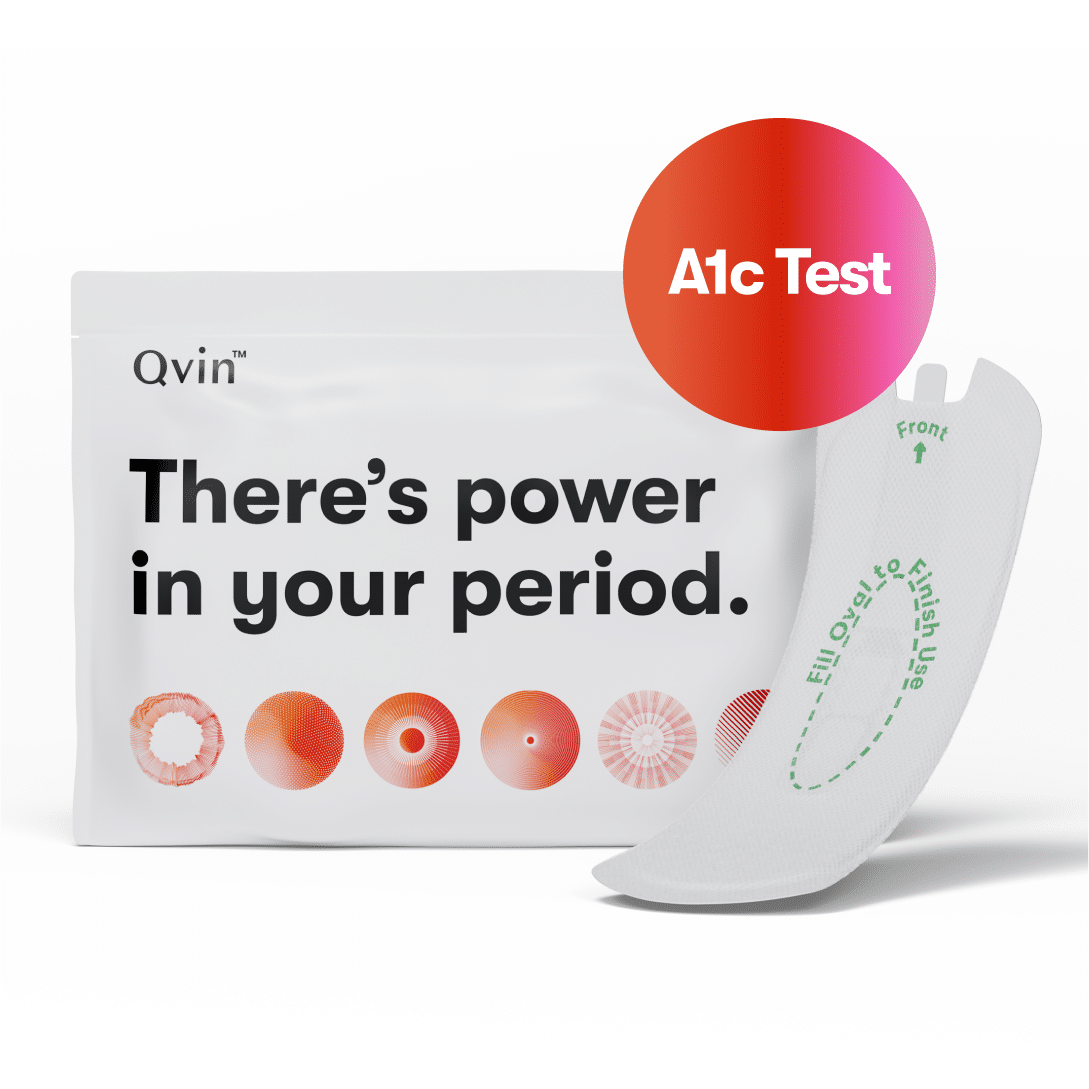
The Q-Pad
A diagnostic menstrual pad with a removable sample.
The Q-Pad looks and wears like an ordinary menstrual pad. Inside it is a removable strip in fluidic contact with the absorbent core. After wear, the strip is detached, sealed in shipping packaging, and mailed at room temperature. By the time it reaches the laboratory, the menstrual blood on the strip has dried — yielding a stable, high-quality Dried Menstrual Sample suitable for molecular, chemistry, immunoassay, and multi-omics workflows. The Q-Pad is the first menstrual blood collection device cleared for diagnostic sample collection by the U.S. FDA, with parallel CE and UKCA marks [1].
- FDA · CE · UKCA cleared / marked diagnostic device
- r > 0.9 correlation with venous blood across HbA1c, TSH, AMH and more [2]
- Room temp postal-system shipping with validated stability [3]
- No new behavior collected in the course of a monthly behavior already in place
What arrives at home
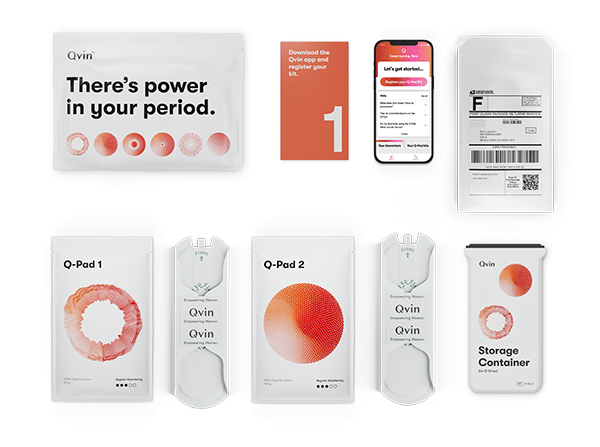
A Q-Pad Kit arrives in a slim mailer. Inside: two individually pouched Q-Pads (Q-Pad 1 and Q-Pad 2), each with an embedded Q-Strip; a Q-Strip Container that protects the used Q-Strip during drying and return shipment; the kit's Instructions for Use; and a pre-paid return mailing pouch sized for standard post. Each Q-Pad Kit carries a unique Kit ID; Q-Pad 1's outer pouch shows a UDI as a QR code that the companion Qvin app scans to register the kit; the Q-Strip itself has its own UID so identity is preserved end to end. No needles, no clinic visit, no cold chain.
The Dried Menstrual Sample strip
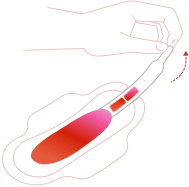
The DMS strip sits inside the absorbent core of the pad in fluidic contact with the menstrual flow. After wear, the strip detaches by hand, the user seals it in the supplied container, and drops the return mailer in standard post. By the time the strip reaches the lab, the sample has dried — yielding a Dried Menstrual Sample that's stable for shipping and analysis.
From home to lab
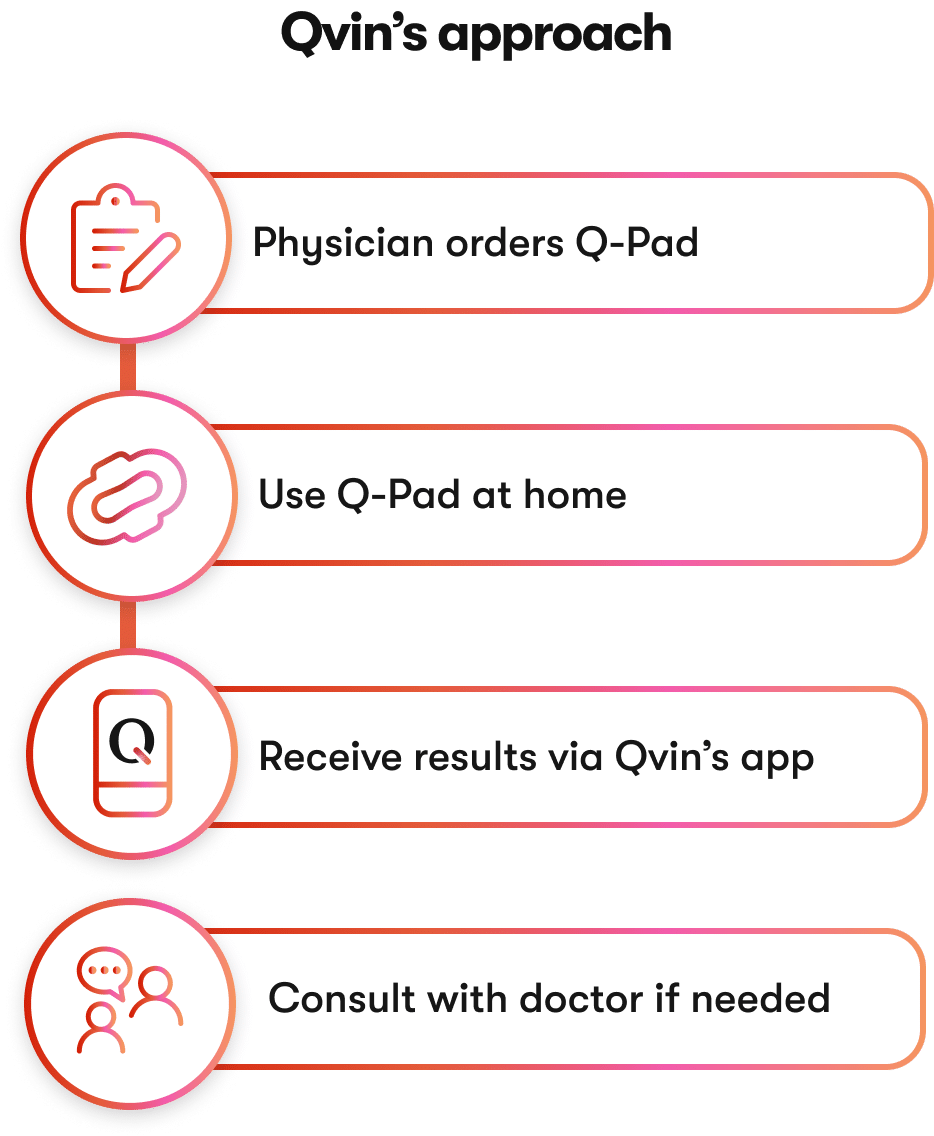
For the patient
Used like any pad — no behavioral change, no cold chain, no special handling. After wear, the user removes the DMS strip, places it in the Qvin shipping pouch (sample-stable, room-temperature mailable), and drops it in standard post. A companion mobile app guides collection, captures kit identifiers, and tracks the sample through the lab. Because dried menstrual sampling is layered onto a recurring behavior, compliance becomes a property of biology, not motivation.
For the lab
At Qvin Labs (or a partner lab), the strip is accessioned, eluted, and routed to the appropriate analytical workflow. Because the substrate is dry, sample-handling conventions are closer to those of a Dried Blood Spot than a venous draw — meaning decades of established laboratory infrastructure transfer cleanly [4]. CLIA-compliant Laboratory Developed Tests run alongside FDA-cleared assays, with discovery work feeding back into the regulated menu over time.
Sample stability
Drying menstrual blood at the point of collection is what makes the rest of the system work. The stability framework supporting Q-Pad submissions to the FDA shows the Dried Menstrual Sample tolerating a range of postal-system conditions, including temperature excursions across a –20 °C to +60 °C window followed by a multi-week post-shock window during which samples remain analytically valid for HPV DNA measurement [3]. Practically, that means a Q-Pad can be collected in a U.S. household, sit in a hot mailbox, cross a continent, and still arrive at the lab clinically usable — without cold chain.
What can be measured from a DMS
Dried Menstrual Samples support the analytical surface of Dried Blood Spots [4][5], with additions specific to menstrual fluid (endometrial cells, cervicovaginal fluid components):
- Molecular — DNA, RNA, methylation. HPV genotyping is the lead clinical assay; STIs, bacterial vaginosis, and broader pathogen panels follow on the same regulator-cleared molecular partner platform.
- Chemistry & immunoassay — HbA1c, hormones (TSH, AMH, FSH, LH), proteins. Validated correlation with venous blood at r > 0.9 across multiple targets [2].
- Multi-omics — proteomics, metabolomics, methylomics. Active discovery work runs through institutional research collaborations; specific collaborators are reserved until individually cleared for public disclosure. See Science and Conditions.
Regulatory pathway
The Q-Pad is the first — and currently only — menstrual blood collection device cleared for diagnostic sample collection by the FDA [1], with parallel CE marking visible in the EU's EUDAMED database [7] and UKCA registration on the UK MHRA's public register [8]. Just as critically, the analytical protocols supporting the FDA clearance — interference, shipping, and stability characterizations — were developed alongside FDA review and serve as predicate methodology for subsequent assays on the same collection platform. The first device through is what defines what regulated menstrual blood diagnostics look like; subsequent devices submit against that template.
Beyond 510(k) cleared assays, the Qvin laboratory operates as a CLIA-certified facility, allowing Qvin and research partners to deploy Laboratory Developed Tests on Dried Menstrual Samples for use cases where the validation bar is institutional rather than federal — common in academic and pharmaceutical research, biomarker discovery, and pre-clinical translational work. HPV, STIs, and bacterial vaginosis are the lead regulator-track analyzer-based menus, run on the leading global molecular diagnostic platform under Material Transfer Agreement frameworks that don't lock the platform to any single counterparty.
The menstrual cup — research kit
Live cells for discovery, not for population scale.
Some of what makes menstrual blood biologically rich — intact endometrial epithelial cells, intact immune populations, fresh nucleic acids in solution — only survives if the sample stays alive and hydrated. For that discovery-stage work, Qvin uses a menstrual-cup-based research kit. Cup samples ship cold, fast, and in small numbers; they're used to identify candidate biomarkers and cell-level signals that can then be translated into molecular assays running, at population scale, on Q-Pad-collected DMS.
Strategic role
The cup is a research instrument — an upstream input to the platform. Its value is in finding what to measure. Once a target is validated, translation work shifts to the Q-Pad, which carries the assay forward into the screening, monitoring, and clinical-trial settings where scale matters.
Why not for the general population
Two structural problems make cups unsuitable as a general consumer collection format:
- High barrier of entry. Cups require insertion technique most first-time users abandon before they're proficient [6]. Population-scale screening can't run on a behavior people opt out of.
- Cold chain dependency. Live cells degrade at room temperature; cup samples must ship cold and fast to preserve cellular and nucleic-acid integrity. That's expensive, fragile, and operationally complex — the opposite of what an at-home, mailed-collection program needs to scale.
Tampons
A hygiene product, not a diagnostic substrate.
Tampons get raised in adjacent self-collection conversations, so it's worth being explicit. Two structural problems:
- Cotton-bound samples are hard to retrieve. Compressed cotton fibers absorb plasma, cells, and analytes deep into the matrix; eluting them quantitatively for downstream analysis is expensive, lossy, and difficult to standardize.
- Stabilization buffers are a shipping hazard. Any chemistry added to keep a wet sample stable becomes a dangerous-goods classification problem at the postal level, driving cost, regulatory complexity, and breakage risk. The Q-Pad sidesteps this entirely by drying the sample at the point of collection.
The wider landscape
Where Q-Pad fits among collection alternatives.
The menstrual-format comparison above is one piece of a wider question: which sample-collection approach for women's health diagnostics actually scales? Q-Pad's claim is measured — passive, dried, mailable, low-friction collection that fits an existing menstrual-care behavior. It does not replace every other sample type. Venous blood, vaginal swabs, cups, tampons, and clinician-collected tissue each have contexts where they're useful. The question is which collection format can scale for a given diagnostic use case.
| Collection approach | Strengths | Limitations | What Q-Pad changes |
|---|---|---|---|
| Q-Pad Kit | Passive external collection; dried sample; mailable; fits ordinary pad use; supports decentralized collection | Requires menstruation, adequate flow, correct user handling, and assay-specific validation | Converts menstrual blood collection into a lower-friction, dried-sample workflow |
| Menstrual cup | Captures larger-volume menstrual fluid and live-cell material; useful in some research settings | Requires insertion, removal, cleaning, and faster / colder logistics for wet samples | Q-Pad avoids internal collection and wet-sample handling |
| Tampon | Familiar menstrual product | Cotton matrix complicates extraction; stabilization buffers add shipping and cost risk | Q-Pad uses a purpose-built removable Q-Strip rather than extracting from cotton fibers |
| Clinician-collected venous blood | Gold standard for many blood analytes; mature clinical infrastructure | Requires clinic visit, phlebotomy, appointment availability, and conventional cold-chain logistics | Q-Pad enables at-home collection for assays validated on DMS |
| Self-collected vaginal swab | Strong analytical fit for cervical-screening and STI workflows | Can create discomfort, cultural barriers, or reluctance for some users | Q-Pad offers passive collection without vaginal insertion, where analytically appropriate |
| Endometrial biopsy or specialist-collected uterine sample | Clinically powerful when tissue or direct uterine sampling is needed | Invasive, expensive, requires specialist clinicians (OB/GYN), and is usually reserved for higher pre-test probability cases; infrastructure is unevenly available globally | Q-Pad is not a biopsy substitute, but supports decentralized screening or monitoring use cases where a non-invasive menstrual sample is sufficient |
Putting it together
Why the Q-Pad is the practical winner.
Across the three formats, only the Q-Pad combines population-scale accessibility, room-temperature shipping economics, regulatory clearance, and an analytical surface broad enough to support the full clinical menu. The cup feeds discovery; the tampon is excluded; the Q-Pad carries the platform.
- Anyone can use it — fits the existing monthly behavior; no learning curve.
- Stable in shipping — DMS strip survives the postal system without cold chain [3].
- Regulator-cleared — FDA, CE, UKCA [1], with predicate analytical protocols accepted for new assays.
- Compatible with Dried Blood Spot infrastructure — decades of laboratory science transfer [4][5].
- Recurring — the only sample format that auto-arrives every cycle by virtue of biology.
References
Sources
- U.S. Food & Drug Administration. 510(k) Premarket Notification database — search "Qvin" or "Q-Pad" to retrieve the cleared device record. accessdata.fda.gov.
- Naseri S, Avrutsky MI, Capati C, Desai K, Alvero R, Blumenthal PD. Concordance of hemoglobin A1c and reproductive hormone levels in menstrual and venous blood. F&S Reports 5(1):33–39, 2024. doi.org/10.1016/j.xfre.2023.11.009.
- U.S. Food & Drug Administration. Q-Pad 510(k) decision summary — analytical protocols including shipping & stability characterization for the Dried Menstrual Sample. See FDA 510(k) database for the cleared device record. accessdata.fda.gov.
- McDade TW, Williams S, Snodgrass JJ. What a drop can do: dried blood spots as a minimally invasive method for integrating biomarkers into population-based research. Demography 44(4):899–925, 2007. doi.org/10.1353/dem.2007.0038.
- Lehmann S, Delaby C, Vialaret J, Ducos J, Hirtz C. Current and future use of "dried blood spot" analyses in clinical chemistry. Clinical Chemistry & Laboratory Medicine 51(10):1897–1909, 2013. doi.org/10.1515/cclm-2013-0228.
- van Eijk AM, Zulaika G, Lenchner M, et al. Menstrual cup use, leakage, acceptability, safety, and availability: a systematic review and meta-analysis. The Lancet Public Health 4(8):e376–e393, 2019. doi.org/10.1016/S2468-2667(19)30111-2.
- European Commission. EUDAMED device record for the Qvin Q-Pad Kit. ec.europa.eu/tools/eudamed.
- Medicines and Healthcare products Regulatory Agency. Public Access Registration Database — Qvin manufacturer record 135374. pard.mhra.gov.uk.